Guides · August 28, 2026
Face analysis: how AI reads your skin from a selfie, and how to do it well
The short answer
A face analysis reads visible surface signals from a photo — shine, texture, tone evenness, and hydration cues — and pairs them with a short questionnaire to identify your skin type and build a routine. Good lighting and a bare face determine the accuracy more than the algorithm does.
Search interest in face analysis has grown quickly, and for good reason: it is the fastest way to answer the question every routine starts with — what kind of skin do I actually have? What once required a clinic visit with a multi-spectral imaging device can now happen on your phone in under a minute. But a face analysis is only as useful as your understanding of what it measures. This guide covers how the technology works, the five signals a good analyzer reads, what it cannot see, how to take a photo that gives accurate results, and how to turn a readout into a routine instead of a shopping list.
What is a face analysis?
A face analysis is an assessment of your skin's visible surface characteristics from a photograph, usually combined with a few questions about how your skin feels and behaves. The output is a skin-type reading (dry, oily, combination, normal, or sensitive) plus observations about specific zones: forehead, T-zone, cheeks, and jawline.
The word 'analysis' covers a wide range. At one end is a dermatologist's clinical examination under controlled lighting. In the middle are in-store imaging devices that capture multiple light spectra. At the accessible end are AI-powered phone tools that read a standard selfie. Each level sees a different depth of information, and none of them replaces a medical diagnosis — but for building a cosmetic routine, a good phone-based analysis is usually enough.
How AI face analysis actually works
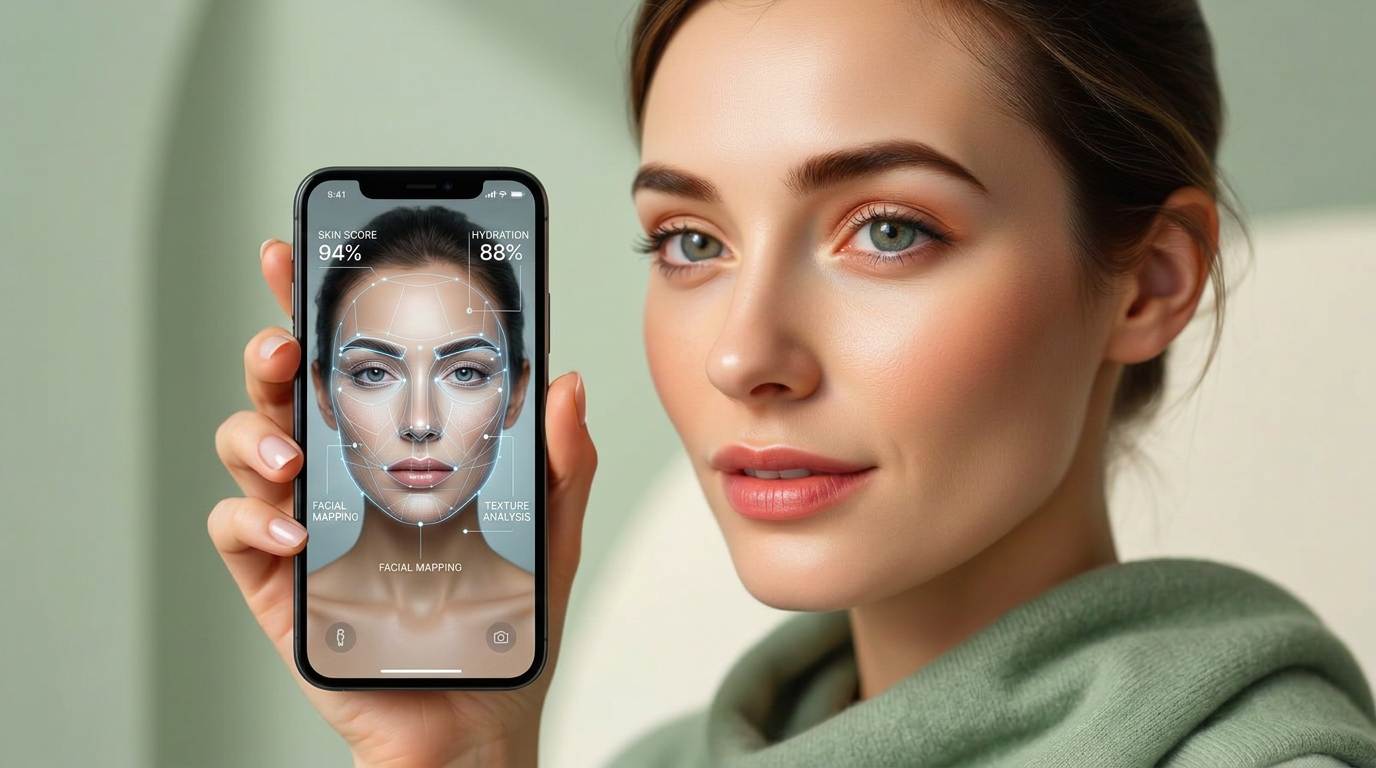
Modern face analyzers use computer-vision models trained on large sets of labeled skin images. When you upload a selfie, the model first locates and maps your face — eyes, nose, jawline — then divides it into zones and examines each zone for specific visual patterns.
The model is not looking at your face the way a person does. It measures pixel-level patterns: where light reflects sharply (suggesting surface oil), where shadows pool in fine lines, how evenly pigment is distributed, and where redness concentrates. It compares these measurements against its training data to classify what it sees.
This is why photo quality matters so much. The model can only read what the camera captured. A selfie in warm, dim bathroom light flattens shine cues and shifts skin tone, and the model will faithfully analyze the wrong information. Garbage in, garbage out applies to skin analysis exactly as it does everywhere else.
The five signals a good face analyzer reads
Not all tools measure the same things, but a useful face analysis covers five core signals. Understanding them helps you interpret any readout you get.
- Shine and oil distribution — where light reflects on the T-zone versus the cheeks, the primary input for skin-type classification
- Visible texture — the smoothness of the surface, including the appearance of pores and fine roughness
- Tone evenness — how uniform your pigmentation is across zones, flagging areas of visible redness or uneven color
- Hydration cues — surface tightness and flaking patterns that suggest water content, distinct from oil
- Zone-by-zone differences — the comparison between areas, which is how combination skin gets identified
What a face analysis cannot tell you
Being honest about the limits makes the tool more useful, not less. A camera-based face analysis reads the surface only. It cannot see below the skin, measure actual sebum production, assess collagen levels, or evaluate skin health in any medical sense.
It also cannot diagnose anything. Acne that is not improving, rosacea, eczema, a mole that is changing, or any painful or spreading condition belongs in front of a licensed dermatologist, not an app. Cosmetic face analysis exists to help you choose and sequence products — cleansers, moisturizers, actives, sunscreen — and that is a genuinely useful job, but it stops there.
How to take a selfie that analyzes accurately
The single biggest factor in analysis accuracy is the photo itself. Follow this protocol and your results will be dramatically more consistent:
- Cleanse your face and wait 30 minutes so your skin returns to its natural state — no moisturizer, no makeup, no sunscreen
- Stand facing a window in soft, indirect daylight; never use a ring light or direct overhead bulb
- Keep the camera at eye level, arm's length, with your whole face in frame and hair pulled back
- Look straight into the lens with a relaxed, neutral expression — smiling compresses the under-eye and cheek zones
- Take the photo on the main rear camera if possible; front cameras are lower resolution and often apply smoothing
Reading your results without overreacting
When a face analysis flags a zone as oily or a texture score as uneven, treat it as a signal to consider, not a verdict to panic over. One bad photo in bad light can shift a reading, so a result worth acting on is one that repeats: run the analysis again in a week under the same conditions before changing your routine.
The most valuable output is the skin-type classification plus the zone map. 'Oily T-zone, normal cheeks' immediately tells you something actionable — light gel hydration on the forehead, richer cream on the cheeks — while a long list of low-scoring metrics usually just tells you to keep doing what works.
From analysis to routine
A face analysis earns its keep only when it changes what you do. The useful path is: analysis identifies your skin type and zones, a short questionnaire adds behavior and sensitivity context, and the combination produces a sequenced AM and PM routine with specific ingredient categories for each step.
That is exactly the flow we built Dermavitas around. The free analysis takes a selfie plus six questions and returns a complete routine — cleanse, treat, hydrate, moisturize, protect — with the reasoning behind every step and pacing guidance for actives so you do not start everything at once. If your readout says combination skin with mild texture concerns, your routine will say exactly which active goes where, on which nights, and what to skip.
Already own products? The same analysis powers the tools that audit them: the Conflict Checker flags actives you should not layer, and Scan My Shelf (Premium) builds a routine from the bottles you already have. Start with the free face analysis and let the data do the deciding.
How often should you re-analyze?
Skin changes with seasons, stress, hormones, and the routine itself. A sensible cadence is a fresh face analysis every four to six weeks, under identical conditions, and always before adding a new active. Weekly progress photos in between give you the trend line that a single snapshot cannot.
If your skin type reading flips between seasons — drier in winter, oilier in summer — that is not an error. It is your skin behaving normally, and your routine should flex with it rather than fight it.
Frequently asked questions
Is a free online face analysis accurate?
For identifying skin type and visible surface characteristics, yes — provided the photo is good. In controlled conditions (bare skin, daylight, steady camera), a well-built AI analyzer agrees with expert assessment on skin type most of the time. It becomes unreliable in bad lighting, with makeup on, or with a beauty-filter camera.
Can a face analysis detect skin conditions?
No, and it should not claim to. Phone-based face analysis reads cosmetic surface signals only. Acne that is not improving, rosacea, eczema, or any changing mole requires a licensed dermatologist.
Do I need a special app or device for face analysis?
No. A modern smartphone camera is sufficient. Clinical devices add extra light spectra and more depth, but for building a daily routine, a phone-based tool like the free Dermavitas analysis gives you what you need.
How is my privacy handled when I upload a selfie?
It depends on the tool, so check before uploading. Dermavitas uses your photo only to generate your analysis and routine, and signed-in users can manage their saved photos from their dashboard. Never upload to a service that does not state its photo policy clearly.
Should I analyze my face before or after skincare?
Before. Cleanse, wait about 30 minutes, and analyze on bare skin. Products — especially moisturizer and sunscreen — change how light reflects off the surface and will skew the reading toward 'hydrated and matte' regardless of your actual skin type.
What should I do with my face analysis results?
Use the skin-type and zone readings to build or adjust a sequenced routine: cleanse, treat, hydrate, moisturize, protect. The free Dermavitas analysis does this step for you, turning the readout into a specific AM/PM plan with ingredient guidance.