Skin analysis · August 18, 2026
Face scanner guide: how to use AI to read your own facial skin like an expert
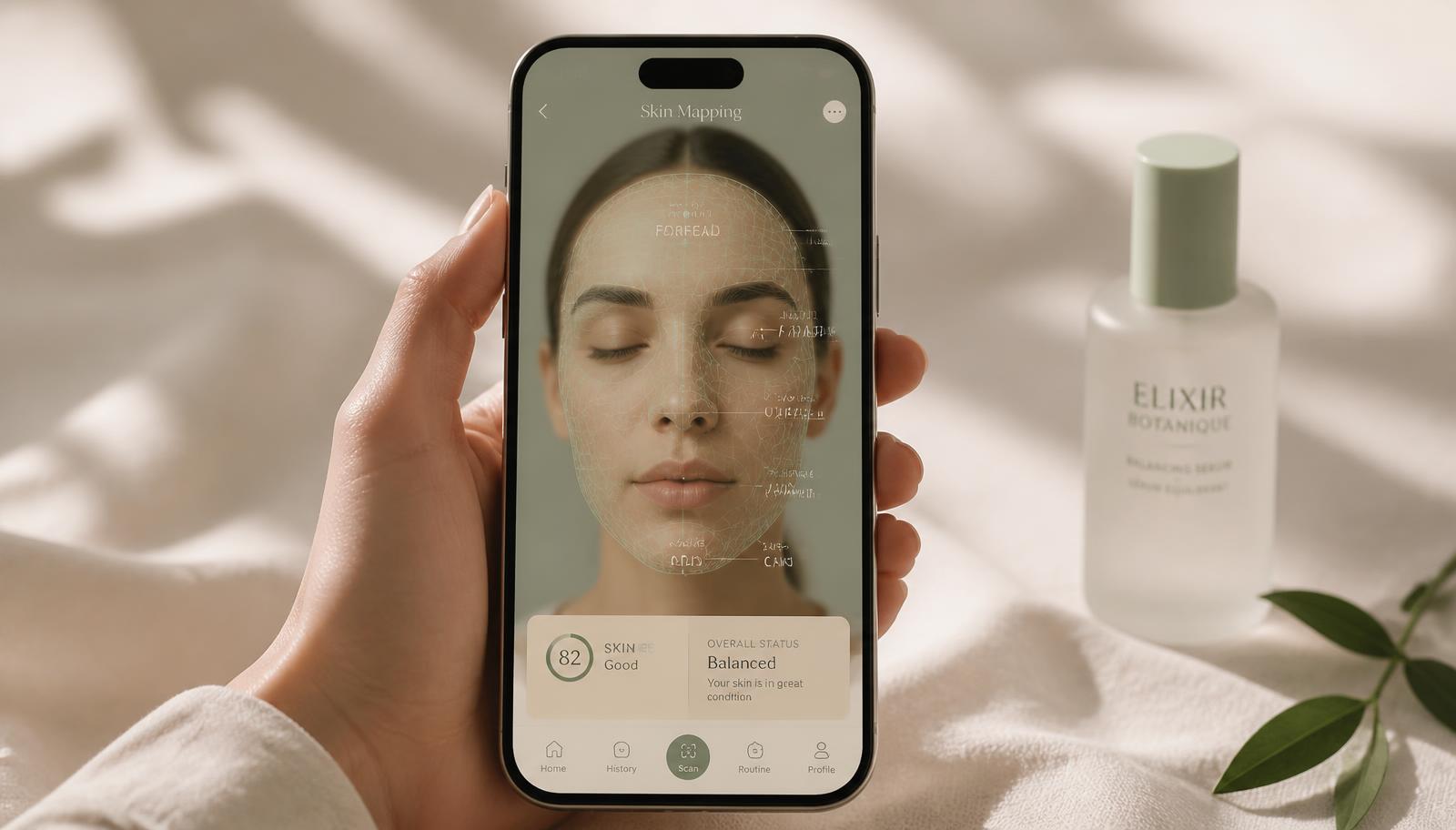
The short answer
An AI face scanner turns a single well-lit bare-face photo into zone-by-zone readings of oil, texture, redness, pores and pigment. Expertise comes from the inputs, not the software: bare skin, flat indirect daylight, rear camera, no filters, and the same setup repeated weekly.
Professionals reading a face are doing something surprisingly reproducible: standardising the light, looking at each zone separately rather than the face as a whole, separating surface signals from things a photo cannot show, and comparing today against a controlled image from a few weeks ago. An AI face scanner can perform all four of those steps — but only if you feed it what an expert would insist on. This guide covers the capture protocol, what each reading actually means, where scans are confidently wrong, and how to convert a scan into changes to the products you already own.
What an AI face scanner is actually measuring
A face scan is computer vision over a photo. The model locates facial landmarks, divides the face into zones, then measures pixel-level properties inside each zone: specular highlights that indicate sebum, local contrast that indicates texture and pore visibility, colour channel shifts that indicate erythema or pigment, and edge patterns along expression lines.
Everything it reports is derived from the surface of your skin as it appeared in that one frame. That is a genuine and useful category of information — it is what a trained eye reads first — but it is a fixed boundary. Nothing beneath the stratum corneum is visible to a phone camera, so hydration depth, barrier integrity, collagen density and sebaceous activity over time are inferred at best.
- Shine and oil distribution, zone by zone
- Texture, roughness and visible pore density
- Redness and diffuse flushing patterns
- Uneven tone, dark marks and post-blemish pigment
- Fine lines and expression-line depth
- Blemish count and where clusters sit
The capture protocol that decides everything
Ninety per cent of the accuracy of a face scan is decided before you press the shutter. A scan of makeup, sunscreen, or skin lit by a warm bathroom bulb is not a scan of your skin — it is a scan of a coating under coloured light, and the model will faithfully report the coating.
Treat capture as a fixed protocol rather than a photo. Write it down once and repeat it identically, because the value of scanning compounds only when the conditions do not move.
- Cleanse and apply nothing for at least an hour — two is better
- Face a window with indirect daylight; never overhead or warm bulbs
- Turn off beauty mode, smoothing and every filter in camera settings
- Use the rear camera at arm's length, eyes level with the lens
- Neutral expression, hair pushed back, whole face in frame
- Same room, same time of day, every single time
How to read each zone the way an expert does
Experts almost never describe a face with one word. They describe a distribution — oily centre, dry edges, redness concentrated at the cheeks, congestion along the jaw — because that distribution is what determines product placement. A face scanner produces exactly this kind of zonal output, and reading it correctly means resisting the urge to collapse it into a single label.
Work through the zones in order and note the pattern rather than the score. A combination pattern is the norm, not an anomaly, and it usually means one moisturizer weight does not belong everywhere on your face.
- Forehead and nose — shine here with dry cheeks means combination, not oily
- Cheeks — the first place to read dryness, redness and sun-related pigment
- Chin and jaw — recurring congestion here tends to be cyclical rather than product-driven
- Around the eyes — thinnest skin; treat as its own zone with lighter texture
- Perioral area — flaking and tightness here often signals over-cleansing
What a face scan cannot tell you, however good it is
The clearest sign of a trustworthy scanner is that it names its own limits. A photo-based face scan is cosmetic guidance about appearance. It is not a diagnosis, and any tool implying otherwise is overselling itself.
Take anything painful, spreading, scaling, bleeding, or changing in size, shape or colour to a licensed dermatologist regardless of what a scan reports. A reassuring score is not clearance, and a poor score is not a condition.
- It cannot diagnose acne, rosacea, eczema, dermatitis or any medical condition
- It cannot assess moles or lesions — those need in-person examination
- It cannot measure hydration depth, barrier function or collagen
- It cannot know your medications, pregnancy status or allergies unless you tell it
- It cannot see what your routine did last week without a prior scan to compare
Where accuracy breaks, and the tone question
Face scanners fail in predictable ways, which makes the failures easy to design around. Warm or overhead lighting distorts redness and tone readings most; residual sunscreen reads as texture or shine; a front camera at close range distorts proportions and often applies smoothing you did not ask for.
Tone deserves specific attention. Models trained on narrow datasets have historically read redness and pigmentation less reliably on deeper skin tones, because both signals rely on colour contrast that shifts with baseline melanin. Flat indirect daylight is the single strongest mitigation, and weighing repeated patterns over any one verdict is the second. Pigmentation concerns such as melasma and post-inflammatory hyperpigmentation are best assessed with a clinician who treats them regularly.
- Any warm, coloured or overhead light source
- Makeup, sunscreen, or a treatment applied the same day
- Front camera, filters, or automatic beauty smoothing
- Scanning immediately after exercise, a hot shower or crying
- Comparing scans taken in two different rooms
Turning a scan into a routine you can actually run
A reading with no action attached is trivia. The point of a face scan is that each signal maps to a step you can adjust — usually with products already on your shelf, because order and frequency are free changes and buying is not.
Change one thing at a time. If three products change at once and your skin improves, you have learned nothing you can repeat, and you have no way to identify the culprit if it worsens.
- Shine in the centre only — lighter gel on the T-zone, keep cream on the cheeks
- Texture and visible pores — one exfoliating or retinoid step, at low frequency, at night
- Redness — pause your strongest active for two weeks before adding anything
- Uneven tone — daily sunscreen first; pigment work is wasted without it
- Tightness after cleansing — the cleanser is too strong, not the moisturizer too weak
Scan weekly, and compare like for like
One scan is a snapshot; a series is evidence. Skin fluctuates daily with sleep, salt, temperature and hormonal cycle, so daily scanning mostly records noise. Weekly scanning in identical conditions matches the six-to-eight-week timescale on which routine changes actually become visible.
Keep the images. A memory of your skin four weeks ago is unreliable in both directions — it flatters slow progress and exaggerates a bad week. Two controlled photos side by side settle the question in seconds.
- Same weekday, same light, same distance, no products
- Log any change you made and the date you made it
- Judge results at four to six weeks, not four days
- Keep the photo history so trends are visible, not remembered
How Dermavitas runs a face scan
Dermavitas was built around the protocol above rather than around a score. The free AI skin analysis takes six questions and one optional selfie, runs in under a minute, and returns a complete AM and PM routine with zone-specific placement, sequencing and pacing — not a number and a paywall.
The photo is optional. If you would rather not upload a face image, the questionnaire path returns a full routine on its own. When you do scan, weekly progress photos are stored in your account so comparisons are like-for-like and you never re-upload the same baseline. Premium adds Scan My Shelf, which reads the products you already own from one photo and sequences them, plus a routine conflict checker and an AI advisor with your scan history in context.
Recommendations are always given as categories with budget bands, never as a single sponsored hero product, and everything is explicitly cosmetic guidance — Dermavitas does not diagnose or treat any condition.
- Free AI skin analysis — six questions, one optional selfie, under a minute
- Zone-aware AM and PM routine with order, frequency and pacing
- Weekly progress photos stored so comparisons stay controlled
- Premium: Scan My Shelf, conflict checker, AI advisor with scan history
- Categories with budget bands, not sponsored single products
Frequently asked questions
How do I use AI to analyze my own face skin?
Cleanse, apply nothing, and wait an hour. Stand facing a window with indirect daylight, disable filters and beauty mode, and take a rear-camera photo at arm's length with a neutral expression. Upload it to a face scanner, then read the output zone by zone — forehead, nose, cheeks, chin, eyes — and map each finding to a single adjustment in the products you already own.
How accurate is an AI face scanner?
Accurate enough to be useful for surface traits — oil distribution, texture, visible pores, redness and uneven tone — when the photo follows a strict protocol. Accuracy drops sharply with makeup, sunscreen, warm indoor lighting or any smoothing filter, because those alter the exact signals being measured. It cannot assess anything below the skin surface.
Is a face scanner the same as a dermatologist?
No. A face scanner gives cosmetic guidance about how your skin looks and how to sequence products. A dermatologist examines skin in person, palpates lesions, tracks change clinically and can prescribe. Anything painful, spreading, scaling or changing in size or colour belongs with a clinician.
What is face mapping and does it work?
Modern face mapping means analysing each facial zone separately, since oil, dryness and congestion are rarely uniform across a face. That is genuinely useful because it determines product placement. The traditional claim that a specific zone maps to a specific internal organ is not supported by evidence.
Do I need a special device for a facial skin analysis?
No. Clinical imaging devices add cross-polarised and UV light that reveal sub-surface pigment a phone cannot see, but for routine decisions a current phone camera in flat indirect daylight is sufficient. Consistency of lighting matters far more than the hardware.
How often should I run a face scan?
Once a week, in identical conditions. Daily scans mostly capture normal fluctuation from sleep, salt, temperature and hormonal cycle, which reads as change without being change. Weekly scanning over six to eight weeks matches the timescale on which routine changes show results.
Is it safe to upload my face photo to an AI scanner?
A face image is biometric data. Before uploading, check whether the photo is stored or discarded, whether it is used to train models, and whether you can delete it in one action. Prefer tools that answer those three questions plainly and that still return a full result if you decline to upload a photo at all.
Can a face scan tell my skin type?
It can estimate it, and a photo often catches shine a mirror misses. The most reliable method is to combine a scan with the bare-face test — cleanse, apply nothing, wait two hours — and trust the pattern that repeats across several weeks rather than a single reading.
Keep reading
Skin analysis
Free skin checker: how to check your skin and your products with AI in five minutes
14 minSkin analysis
Skin analysis: what it measures, how to do it at home, and how to read the results
15 minAI skincare