Skin analysis · August 22, 2026
Free skin checker: how to check your skin and your products with AI in five minutes
The short answer
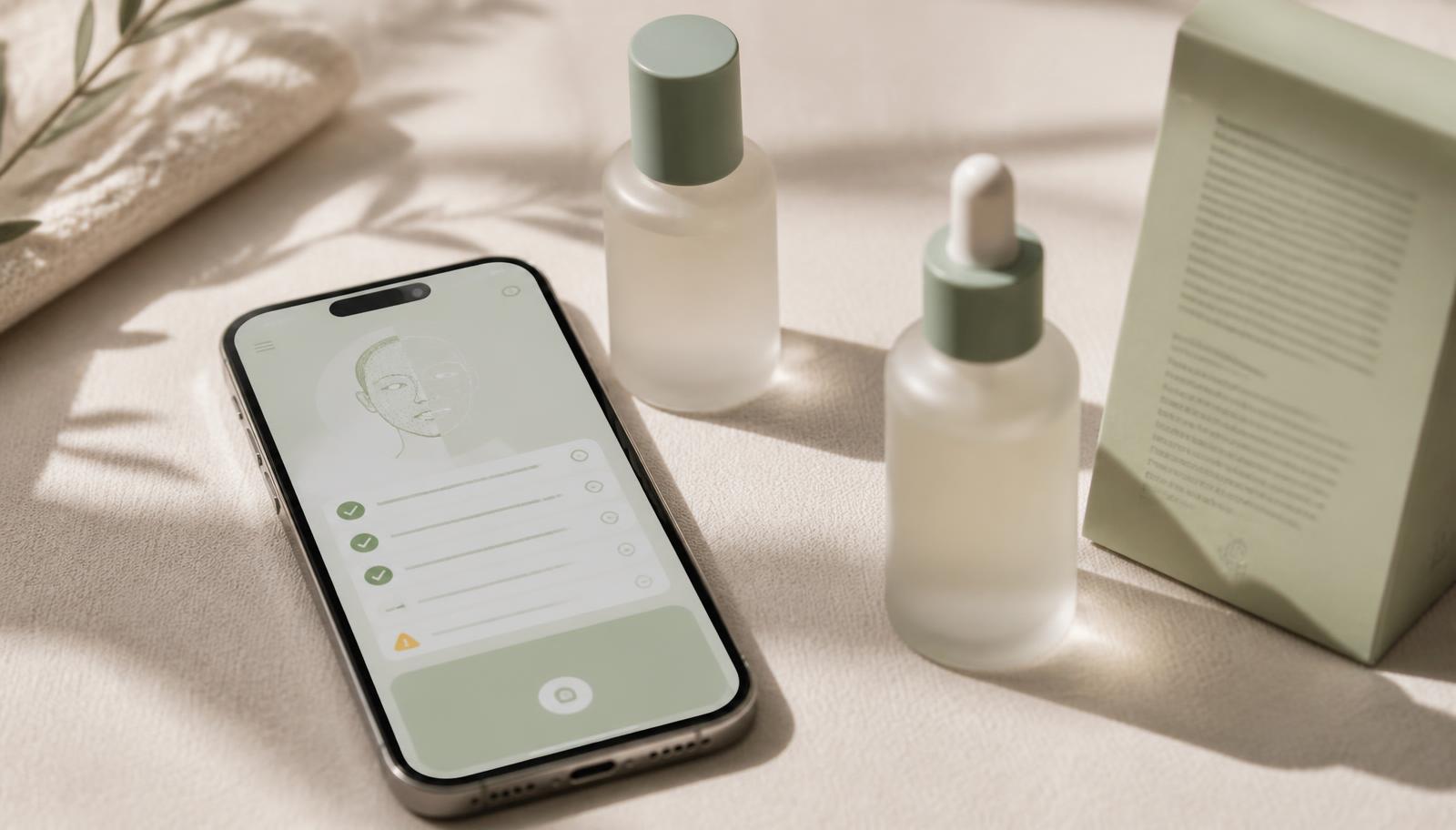
A free skin checker does two jobs: an AI skin analysis reads a bare-face photo and a short questionnaire to describe what your skin is doing right now, and an ingredient checker reads a product's INCI list to say whether it fits that skin and conflicts with anything else in your routine. Run the skin check first, then check every product against the result.
"Skin checker" gets typed into search for two very different reasons. Some people want to know what their skin is doing — oily where, dry where, red where, and what to change. Others are standing in an aisle or holding a bottle they already bought, wanting to know whether the ingredient list is a good idea for them. Both are answerable for free in about five minutes, and they are far more useful in sequence than alone: a skin check gives you the criteria, and an ingredient check applies them. This guide covers what each check can genuinely determine, the exact process, how to read the output without over-reading it, and where a checker stops and a dermatologist starts.
The two checks people mean by "skin checker"
The first is a skin check: an AI skin analysis over a photo plus a few questions about how your skin behaves, returning a description of your current surface state and a routine built around it. The second is a product check: an ingredient checker that reads a label — the INCI list — and tells you what the actives are, at roughly what role, and what in your existing routine they fight with.
Neither replaces the other. A skin check with no product check leaves you buying blind; a product check with no skin check has no standard to judge against, which is why generic "is this ingredient good?" verdicts are close to useless. Good for whom, at what frequency, layered under what?
- Skin check — reads your skin: oil, texture, redness, tone, blemish pattern
- Ingredient check — reads a label: actives, role, strength cues, conflicts
- Skin check sets the criteria; ingredient check applies them to a bottle
- Both are cosmetic-fit questions, not medical questions
The five-minute process, in order
Do it in this order and you only have to do the slow part once. The skin check produces a profile you then reuse for every product decision afterwards, including things you already own.
The whole thing is short by design. Long questionnaires do not produce better routines — they produce abandoned questionnaires. What matters is that the few inputs you give are accurate.
- 1. Cleanse, apply nothing, and wait at least an hour before photographing
- 2. Run the skin check: bare-face photo in flat indirect daylight plus the questions
- 3. Write down the three signals it flags most strongly
- 4. Photograph or type the ingredient list of each product you own or want
- 5. Check each against your profile — keep, reposition, reduce frequency, or drop
- 6. Rebuild AM and PM from what survives, and buy only for a real gap
How to check your skin properly (the part people get wrong)
A skin checker reports what was in the frame. Makeup, sunscreen, a treatment applied that morning, or a warm bathroom bulb will all be read as skin, and the result will be confidently wrong. This is the single biggest cause of "the app said I'm oily and I'm not".
Standardise the capture once and repeat it. Consistency matters more than camera quality: a three-year-old phone in the same window light every week beats a new phone in a different room each time.
- Bare skin, nothing applied for an hour or more
- Indirect daylight from a window — never overhead or warm bulbs
- Rear camera, arm's length, eyes level with the lens
- Filters, smoothing and beauty mode fully off
- Neutral expression, hair back, whole face in frame
- Same room, same time of day, every repeat check
How to check a product's ingredient list
INCI lists are ordered by concentration down to 1%, after which order stops meaning anything. That single rule does most of the work: an active in the last third of a long list is likely present at a marketing quantity, and an active in the first five is doing real work whether you wanted it to or not.
An ingredient checker's value is not a purity score. It is identifying which of the twenty-odd names actually change your skin, and flagging the specific combinations that cause the irritation people usually blame on the wrong product.
- Read the first five ingredients and the last third separately
- Find the actives: retinoids, acids, vitamin C, benzoyl peroxide, niacinamide
- Note the frequency the strongest active implies — nightly is rarely correct at the start
- Check for duplicates: two exfoliants across two products is one too many
- Fragrance and essential oils near the top matter if you flush or sting easily
- "Clean", "natural" and hazard scores are marketing, not fit for your skin
The conflicts a checker should catch for you
Most bad reactions are not caused by a bad product. They are caused by two reasonable products used in the same routine at the same time, at a frequency neither label mentions because neither label knows about the other.
These are the pairings worth checking on every new purchase. If a checker flags one, the fix is usually alternating nights, not throwing anything away.
- Retinoid plus exfoliating acid on the same night
- Two exfoliants hiding in a cleanser and a toner
- Benzoyl peroxide layered with a retinoid in the same step
- A high-strength active added while skin is already visibly red
- Three new products started in the same week, so nothing is attributable
- Any active routine with no daily sunscreen underneath it
What a free skin checker cannot tell you
A photo-based check reads the surface of your skin as it appeared in one frame. That covers appearance well and covers everything else not at all. A checker that names its own limits is more trustworthy than one that returns a confident number for everything.
Nothing a checker says is a diagnosis or a clearance. Anything painful, spreading, scaling, bleeding, or changing in size, shape or colour belongs with a licensed dermatologist regardless of what any score says.
- It cannot diagnose acne, rosacea, eczema or dermatitis
- It cannot assess moles, lesions or anything requiring in-person examination
- It cannot measure hydration depth, barrier function or collagen
- It cannot predict an allergy — patch test regardless of what a label check says
- It cannot know your medications or pregnancy status unless you tell it
- It cannot see whether last month's change worked without a prior check to compare
Turn the two checks into an AM and PM routine
The output of both checks converges on one thing: an order and a frequency for the products that survived. Order is free, frequency is free, and between them they fix more skin than the next purchase does.
Change one variable at a time and give it four to six weeks. If three things change at once and your skin improves, you have learned nothing repeatable.
- AM — cleanse or rinse, treat lightly, moisturize, sunscreen every day
- PM — cleanse, one active on its scheduled nights, moisturize
- Lighter texture where the check found shine; richer where it found dryness
- Start any new active twice weekly, not nightly
- Re-check weekly in identical conditions; judge results at four to six weeks
The Dermavitas free AI skin analysis
Dermavitas runs both checks for free, in the order above. The free AI skin analysis is six questions plus one optional selfie and takes under a minute; it returns a complete AM and PM routine with placement, sequencing and pacing — not a score behind a paywall. The photo is genuinely optional: the questionnaire path returns a full routine on its own if you would rather not upload a face image.
The free ingredient side is Should I Buy This? — paste or photograph a label and it identifies the actives, tells you whether they fit the skin profile your analysis produced, and flags conflicts with what you already use. The ingredient library covers the individual names in plain language when you want the background.
Recommendations are always categories with budget bands rather than one sponsored hero product, and everything is explicitly cosmetic guidance: Dermavitas does not diagnose or treat any condition. Free accounts keep your baseline photo so weekly progress comparisons stay like-for-like without re-uploading. Premium adds Scan My Shelf, which reads a whole shelf from one photo and sequences it, plus a routine conflict checker and an AI advisor that has your check history in context.
- Free AI skin analysis — six questions, optional selfie, under a minute
- Should I Buy This? — free ingredient checker against your own skin profile
- Full AM/PM routine with order, frequency and pacing, not just a score
- Baseline photo stored so weekly re-checks are controlled comparisons
- Premium: Scan My Shelf, conflict checker, AI advisor with history
Frequently asked questions
Is there a free skin checker that actually works?
Yes, for surface traits. A free AI skin check over a bare-face photo in flat daylight can read oil distribution, texture, visible pores, redness, uneven tone and blemish pattern reliably enough to build a routine from. The Dermavitas free AI skin analysis takes six questions and one optional selfie and returns a full AM and PM routine rather than a score.
How do I check my skin online?
Cleanse and apply nothing for at least an hour, then photograph your bare face with the rear camera in indirect daylight with all filters off. Upload it to a skin checker along with answers about how your skin behaves through the day, and read the result zone by zone rather than as a single label.
What does an ingredient checker actually check?
It parses the INCI list to identify which ingredients are active rather than base or texture, estimates their prominence from list position, and flags conflicts with your other products — for example a retinoid and an exfoliating acid scheduled on the same night, or two exfoliants hidden in a cleanser and a toner.
Can a skin checker tell if a product is bad for me?
It can tell you whether the product fits your skin profile and clashes with your routine, which is the question that usually matters. It cannot predict an individual allergy or sensitivity, so patch test a new product on your inner forearm or jawline for a few days regardless of what a check says.
Is a free skin checker the same as seeing a dermatologist?
No. A checker offers cosmetic guidance about how skin looks and how to sequence products. A dermatologist examines skin in person, tracks change clinically and can prescribe. Anything painful, spreading, scaling, bleeding or changing in size, shape or colour belongs with a clinician.
How often should I re-check my skin?
Weekly, in identical conditions. Skin fluctuates daily with sleep, salt, temperature and hormonal cycle, so daily checks mostly record noise. Weekly checks over six to eight weeks match the timescale on which routine changes become visible.
Do I have to upload a photo of my face?
Not with Dermavitas — the questionnaire path returns a complete routine without an image. A face photo is biometric data, so before uploading to any tool, check whether it is stored, whether it is used to train models, and whether you can delete it in one action.
Does a free skin checker recommend products to buy?
Good ones start with what you already own, because order and frequency are free changes and most shelves already contain most of a workable routine. Dermavitas recommends categories with budget bands rather than a single sponsored product, and only suggests buying when a real gap exists.
Keep reading
Skin analysis
Face scanner guide: how to use AI to read your own facial skin like an expert
15 minSkin analysis
Skin analysis: what it measures, how to do it at home, and how to read the results
15 minAI skincare