AI skincare · August 11, 2026
Acne face map: what breakouts on your forehead, chin, cheeks, and jawline actually mean
The short answer
An acne face map is a pattern tool, not a diagnosis. Where you break out reliably reflects local causes — oil density, friction, hair and haircare products, phone and mask contact, and hormonal timing — not the health of a specific internal organ. Forehead and nose breakouts usually track oil, sweat, and haircare; cheeks track contact and friction; chin and jawline breakouts track hormonal cycles.
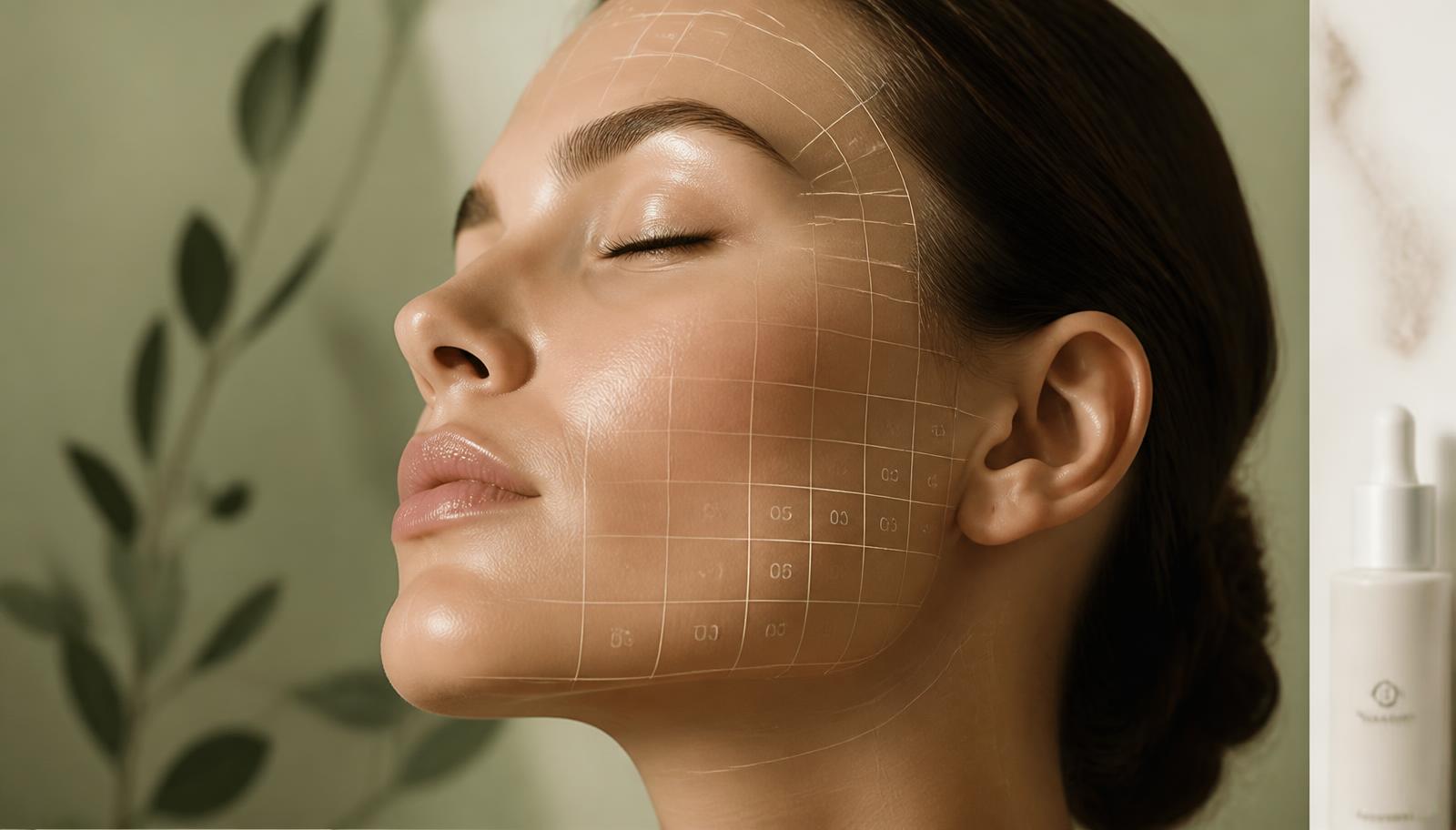
Face maps are everywhere on skincare TikTok, usually drawn as a diagram assigning each zone to an organ: forehead means your liver, chin means your stomach, cheeks mean your lungs. That version comes from traditional Chinese medicine and has never held up in dermatology research. But the reason face mapping refuses to die is that the underlying observation is correct — acne genuinely is not distributed randomly. Different regions of your face have different oil gland densities, get touched by different things, and respond to different triggers. This guide replaces the organ chart with the version that actually predicts something, zone by zone, and shows you how to turn a pattern into changes in your routine.
Why face mapping works — and why the organ chart doesn't
Two separate claims get bundled together under "face mapping." The first is that breakout location carries information. That is true and uncontroversial: sebaceous gland density varies across the face, sweat and friction vary, and hormone-sensitive follicles are concentrated in the lower third. The second claim is that each zone is a readout for a specific internal organ. There is no mechanism for that and no clinical evidence behind it.
The practical difference matters. The organ version sends you to a detox tea for forehead spots. The dermatological version sends you to your hair conditioner, your hat, and how long you leave sweat on your skin — the things you can actually change and test.
So read a face map as a source of hypotheses about local causes, not as a diagnosis of what is happening inside you. When you find a pattern, change one variable and give it a full skin cycle to answer.
- Location reflects oil density, friction, contact, and hormones.
- Location does not reflect liver, lung, kidney, or stomach health.
- Patterns are useful as a test list, never as a verdict.
Forehead and hairline: oil, sweat, and everything in your hair
The forehead sits in the T-zone, one of the densest regions for oil glands, and it is also the region most exposed to whatever is in your hair. Leave-in conditioners, oils, dry shampoo, styling creams, and heavy hair masks migrate down when you sweat or sleep, and they can clog follicles along the hairline in a very recognisable band.
Small uniform bumps clustered tight to the hairline, or in a line where a hat, headband, or helmet sits, point to a contact cause rather than a systemic one. Sweat that dries on skin after a workout does something similar: it is not the sweat itself but the delay in cleansing.
This zone responds well to lightweight leave-on exfoliation and to fixing the mechanics, in that order. Salicylic acid is the classic choice here because it is oil-soluble and works inside the follicle rather than only on the surface.
- Rinse the hairline last in the shower, after conditioner is out.
- Cleanse within about thirty minutes of finishing a workout.
- Wash hats, headbands, and pillowcases weekly.
- Use a leave-on BHA two to three nights a week, not daily at first.
Nose and inner cheeks: pores, blackheads, and mistaken identity
Most of what people call "nose acne" is not inflammatory acne at all. Visible pores and dark dots on the nose are usually open comedones and oxidised sebum in an area with genuinely large glands. They are not dirt, and no amount of scrubbing shrinks the pore opening permanently.
The other frequent mix-up is small, dry, non-red bumps around the nose and inner cheeks, which is often congestion or a barrier problem rather than acne. Treating that with strong acne actives makes it visibly worse — flaking, tightness, and more redness within a week.
The useful test is inflammation. If bumps are red, tender, or come to a head, treat them as acne. If they are skin-coloured, painless, and permanent-feeling, you are managing texture and oil, which is a retinoid-and-consistency job over months.
Outer cheeks: contact, friction, and your phone
The outer cheeks have fewer oil glands than the T-zone, so persistent breakouts there usually have an external explanation. Phone screens held against one side, pillowcases, mask edges, sports gear straps, and hands resting on a cheek at a desk all create the same picture: breakouts concentrated on one side or in a defined band.
One-sided acne is the single most diagnostic pattern on the whole face. If your left cheek breaks out and your right does not, the cause is almost certainly something touching your left cheek, not something internal.
Cheeks are also where over-treatment shows up first, because the skin here is thinner and drier than the T-zone. If your cheeks feel tight and look pink while your nose is still oily, your routine is too aggressive for your face as a whole and needs zone-aware application rather than a stronger product.
- Wipe your phone daily; switch to speaker or earbuds for long calls.
- Change pillowcases twice a week and note which side you sleep on.
- Apply actives to the T-zone first, cheeks last with whatever remains.
Chin and jawline: the one zone that really is hormonal
The lower third of the face — chin, jawline, and upper neck — has follicles that are unusually sensitive to androgens. That is why hormonal acne has a recognisable signature: deeper, tender, slower lesions along the jaw, often flaring in the week or so before a period and settling afterwards.
Two things distinguish this pattern from ordinary congestion. It is cyclical, and it is deep. Surface exfoliation does very little for it, which is why people cycling through cleansers get frustrated: the lesion is forming well below where a wash can reach.
The cosmetic approach here is to reduce inflammation and keep the barrier intact rather than to attack each spot. Adapalene, azelaic acid, and consistent non-stripping cleansing help. Persistent, painful, or scarring jawline acne is a legitimate reason to see a dermatologist, because the effective treatments for it are often prescription and sometimes hormonal — a conversation Dermavitas explicitly does not replace.
- Cyclical plus deep plus jawline equals likely hormonal.
- Don't escalate exfoliation for lesions that form deep.
- Track flares against your cycle for two months before changing anything.
- Scarring or painful nodules are a dermatologist conversation.
Between the brows, temples, and mouth: the smaller signals
Between the brows sits in the oiliest strip of the face and is also where sunscreen and makeup get pushed around by glasses. Recurrent single spots in exactly the same place often follow a nose pad or a frame edge.
Temples are a hairline-adjacent zone, so treat them like the forehead: haircare, hats, and sweat first. Around the mouth, breakouts commonly follow lip balms, toothpaste residue, and — importantly — the perioral dermatitis pattern, which looks like small clustered bumps with scaling and gets worse with steroid creams and heavy occlusives. That one is not acne and needs a clinician.
The pattern to be most careful with is anything that appears symmetrically and suddenly across several zones at once. Symmetry and speed usually point to something systemic like a new medication or a product reaction, not to a local cause you can rub out.
How to turn your face map into a routine that changes something
A map is only useful if it produces a decision. The workflow that reliably works is: photograph, name the zones, list the local causes for those zones, change one variable, then wait one skin cycle of four to six weeks before judging.
Multi-zone breakouts almost never need multi-product escalation. In practice most people get further by applying one leave-on exfoliant or retinoid to the whole face at a low frequency, then addressing the mechanical causes per zone — hair, phone, pillowcase, sweat timing — than by buying a spot treatment for each region.
This is also where photographs beat memory. Under identical lighting, four weeks apart, a fading pattern is obvious. From memory it is not, which is why so many people abandon a product that was working at week three.
- One selfie a week, same window, same time, bare skin, no filter.
- One change at a time, held for four to six weeks.
- Whole-face actives, zone-specific habit fixes.
- Write down the change and the date, or the experiment doesn't count.
Where an AI skin analysis fits in
Reading your own pattern honestly is hard: you see your face every day, you remember the worst week, and lighting lies. An AI skin analysis is useful precisely at this step, because it reads the visible distribution from a photo consistently and pairs it with your answers about sensitivity, hair habits, climate, and the products you already own.
Dermavitas is a cosmetic tool, so what it returns is a routine and ingredient plan with an application order tuned to your zones — for example, salicylic acid limited to the T-zone with a barrier moisturiser buffering the cheeks. It does not diagnose acne subtypes, hormonal conditions, perioral dermatitis, or anything else medical, and it will tell you when a pattern belongs with a dermatologist.
Used that way, face mapping stops being folklore and becomes what it should have been all along: a structured way of noticing where your skin is asking for something different.
Frequently asked questions
Is acne face mapping real?
Partly. The observation that breakouts cluster by zone is real and reflects oil gland density, friction, contact, and hormone-sensitive follicles. The traditional version that links each zone to an internal organ has no supporting evidence in dermatology.
What does acne on the forehead mean?
Usually oil, sweat left on the skin, or hair products migrating onto the hairline. Bumps in a band where a hat or headband sits, or tight to the hairline, point strongly to a contact cause rather than anything internal.
What does jawline and chin acne mean?
The lower third of the face has androgen-sensitive follicles, so deeper, tender breakouts along the chin and jaw that flare cyclically are the classic hormonal pattern. Persistent or scarring lesions there warrant a dermatologist.
Why do I only break out on one cheek?
One-sided acne is almost always mechanical. Look at your phone, the side you sleep on, your pillowcase, a mask edge, a strap, or a habit of resting that hand on your face.
Is Chinese face mapping accurate?
There is no clinical evidence that breakout zones correspond to specific organs. Use zone patterns to find local causes you can test and change instead.
How long before a change to my routine shows on my face map?
Four to six weeks, which is roughly one skin cycle. Judging sooner is the most common reason people abandon something that was working.
Can an AI skin analysis read my breakout pattern?
Dermavitas reads visible cosmetic characteristics from one selfie — shine, texture, congestion, uneven tone by area — and turns them into a personalised AM/PM routine with an application order. It offers cosmetic guidance only and does not diagnose acne or any medical condition.
Keep reading
AI skincare
AI skincare: how artificial intelligence improves your face routine (and where it falls short)
15 minAI skincare
AI skin analysis: what it is, how it works, and how to get a real routine from a free scan
16 minAI skincare