AI skincare · September 16, 2026
Skin analyzer: how the Dermavitas Skin AI Analyzer reads your face (and what the results mean)
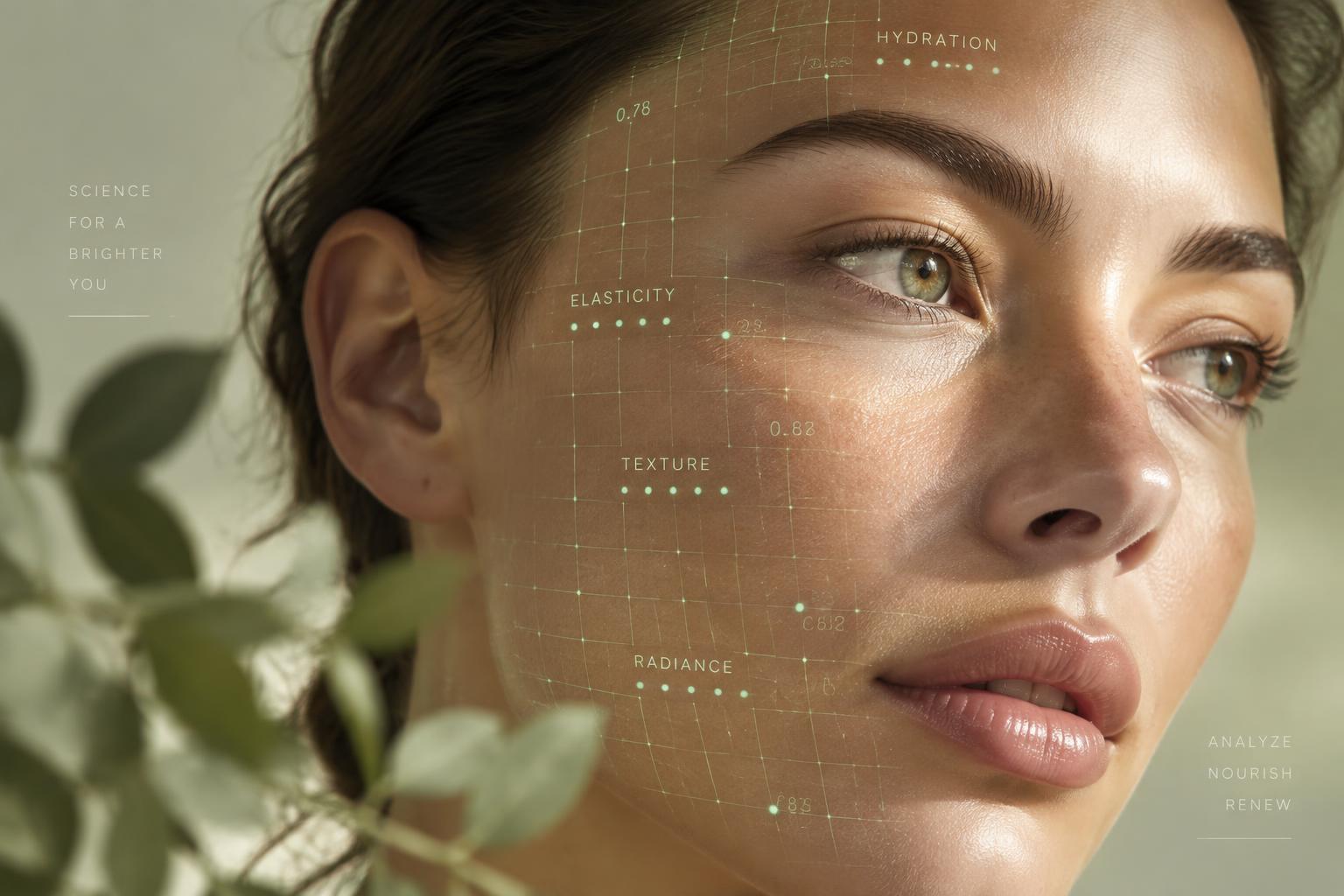
The short answer
A skin analyzer is a tool that reads a photo of your face and reports on visible cosmetic characteristics — shine and oil distribution, surface texture, pore visibility, tone evenness, and hydration cues — usually zone by zone. The Dermavitas Skin AI Analyzer does this free from one selfie plus a short questionnaire, and returns an ordered AM and PM routine instead of a single score. It is cosmetic guidance, not a medical diagnosis.
Most people meet a skin analyzer at the worst possible moment: standing under a bathroom downlight, holding a phone, hoping a number will explain years of trial and error. The number rarely helps. What does help is a structured read of what is visibly happening on each part of your face, paired with the context a photo cannot see — how your skin reacts, what you already own, what climate you live in. This guide explains what a skin analyzer genuinely measures, where the technology is reliable and where it quietly fails, how to capture a photo worth analyzing, and how the free Dermavitas Skin AI Analyzer turns a reading into a routine you can follow tonight.
What is a skin analyzer?
A skin analyzer is software that evaluates the appearance of your skin from an image. It is not looking for disease. It is looking at optics: how light scatters off the surface, where reflections concentrate, how uniform pigment appears across an area, and how shadow collects in pores and fine lines.
Clinic devices do this with controlled lighting, polarized filters, and sometimes UV imaging. A phone-based AI skin analyzer approximates the same readings from ordinary daylight, which is why capture conditions matter more than the model architecture for everyday users.
The scope is cosmetic by design. A skin analyzer can tell you that your chin looks congested and your cheeks look dehydrated. It cannot tell you whether a lesion is dangerous, whether a rash is eczema or a reaction, or whether a breakout is hormonal. Those are questions for a licensed dermatologist.
What the Dermavitas Skin AI Analyzer actually measures
Dermavitas splits the face into zones — forehead, nose, cheeks, chin, and the perioral and under-eye areas — because those zones behave differently. A single global 'oily' verdict is the most common reason people buy the wrong cleanser.
- Shine and oil distribution: where reflection concentrates, and whether it is a classic T-zone pattern or diffuse across the face
- Surface texture: roughness, small bumps, and flaking that suggest either barrier disruption or a need for gentle exfoliation
- Pore visibility: how prominent pores read on the nose and inner cheeks under diffuse light
- Tone evenness: dullness, redness distribution, and post-blemish marks
- Hydration cues: tightness, crepey light response, and flaking that indicate dehydration rather than dryness
- Early fine lines: creasing around the eyes and forehead that responds to retinoids, peptides, and daily sunscreen
How the analysis works, step by step
First the image is normalised: the face is located, landmarks are mapped, and the frame is checked for basic quality — focus, exposure, and whether the face fills enough of the frame. Poor input is rejected rather than guessed at, because a bad photo produces confident nonsense.
Next, a vision-capable model describes each zone in cosmetic terms. Then those descriptions are mapped to ingredient categories — humectants, barrier lipids, niacinamide, azelaic acid, retinoids, chemical exfoliants, mineral or chemical sunscreen — and finally sequenced into an application order with pacing rules so two strong actives never land on the same night.
Your questionnaire answers sit on top of the image read as constraints. Sensitivity caps active strength. Budget filters product tiers. Climate changes moisturizer weight. Products you already own are reused instead of replaced, which is the single biggest difference between a routine you follow and a shopping list you ignore.
- Normalise: locate the face, map zones, verify photo quality
- Describe: report visible characteristics per zone, in plain language
- Map: translate each characteristic into ingredient categories
- Sequence: build AM and PM order with pacing for strong actives
How accurate is a skin analyzer?
For visible surface characteristics under decent light — shine, texture, flaking, pore prominence — a good analyzer is consistent enough to be useful, and repeatable readings matter more than absolute scores. The right test is whether two photos taken minutes apart in the same light return roughly the same report. If they do not, the tool is reading lighting, not skin.
Accuracy drops in predictable places. Makeup and beauty filters erase texture and even tone before the image is saved. Warm indoor light exaggerates redness. Overhead light carves shadows that read as roughness. And tone-dependent readings such as redness and post-blemish marks have historically been weakest on deeper skin tones, which is a further reason to treat all output as cosmetic guidance.
Skin age estimates deserve particular scepticism. They are entertaining and largely arbitrary. Nothing in your routine should change because a number moved by three years.
How to take a photo the analyzer can trust
Capture protocol is the whole game. Stand facing a window in indirect daylight, not with the window behind you. Clean skin, no makeup, at least an hour after your last product so moisturizer shine is not mistaken for oil. Hair pulled back, neutral expression, camera at eye level about an arm's length away. Beauty mode off — it is on by default on many phones.
If you want comparable results over time, standardise everything: same window, same time of day, same distance, same expression. A skin analyzer is far more valuable as a repeated measurement than as a one-off verdict.
- Indirect daylight, facing the window
- Bare, product-free skin; no filters or beauty mode
- Eye-level camera, arm's length, neutral face
- Same setup every time so scans are comparable
How to choose a skin analyzer worth using
Green flags: the tool explains each finding rather than only scoring it, asks context questions before recommending anything, produces an ordered routine with pacing, works without a photo if you decline to upload one, and states plainly how long it keeps your image and how to delete it.
Red flags: a single mystery score, instant product links with no reasoning, medical-sounding claims about conditions, every finding paywalled before you see anything, and vague or missing answers about photo retention and model training. A face photo is biometric data — the retention question is not a formality.
Turning your reading into a routine
A report is only useful once it changes what you touch tonight. Start with the four-slot core: cleanse, treat, moisturise, and protect in the morning. Match the cleanser to your oil pattern, the treatment to your single top concern, the moisturiser to your hydration reading, and never skip daily sunscreen — it is the one step that protects every other result.
Introduce one new active at a time, roughly two weeks apart, so you can attribute both improvement and irritation. Give the routine four to six weeks — about one turnover cycle — before judging it, then re-scan under identical conditions and compare zone by zone rather than by overall impression.
Using the Dermavitas Skin AI Analyzer free
The Dermavitas Skin AI Analyzer is free to try at dermavitas.com/analysis, with no card required. Upload a selfie, answer a short questionnaire, and you receive a zone-by-zone cosmetic reading plus a complete AM and PM routine with application order, pacing, and the reasoning behind every recommendation. If you prefer not to upload a photo, the questionnaire alone still returns a full routine.
Your selfie is stored privately in your account so you never have to upload it twice, is never used to train models, and can be deleted at any time. Premium adds progress photo tracking, shelf scanning for products you already own, and routine conflict checking — but the first analysis, and the routine it produces, cost nothing.
Frequently asked questions
What is a skin analyzer?
A skin analyzer is a tool that evaluates a photo of your face and reports on visible cosmetic characteristics such as shine and oil distribution, surface texture, pore visibility, tone evenness, and hydration cues. Better analyzers report per zone and explain what each finding means for your routine.
Is the Dermavitas Skin AI Analyzer free?
Yes. The Dermavitas Skin AI Analyzer is free at dermavitas.com/analysis with no card required. You get a zone-by-zone reading and a complete AM and PM routine. Premium tiers add progress photo tracking, shelf scanning, and routine conflict checking.
How accurate is an AI skin analyzer?
For visible surface characteristics in good indirect daylight, results are consistent enough to guide product choices. Accuracy falls with makeup, filters, warm indoor light, or overhead lighting, and tone-dependent readings such as redness are least reliable on deeper skin tones. Output is cosmetic guidance, not a diagnosis.
Can a skin analyzer diagnose skin conditions?
No. Skin analyzers assess appearance only. They cannot diagnose acne as a disease, identify eczema or rosacea, or screen moles for skin cancer. See a dermatologist for anything persistent, painful, changing, or spreading.
Do I need to upload a photo to use it?
No. The questionnaire alone returns a full AM and PM routine. The photo adds zone-level cosmetic detail, and if you do upload one it is stored privately in your account, never used for model training, and deletable at any time.
How often should I use a skin analyzer?
Every four to six weeks, which is roughly one skin turnover cycle. Use the same window, time of day, distance, and expression each time so the readings are comparable and you can see whether your routine is actually working.
Is a skin analyzer the same as a clinic skin scan?
Not quite. Clinic devices use controlled and sometimes polarized or UV lighting to capture signals below the surface. A phone-based AI skin analyzer approximates surface readings in ordinary daylight, which makes it excellent for routine building and tracking, but not a replacement for professional assessment.
Keep reading
AI skincare
AI skincare: how artificial intelligence improves your face routine (and where it falls short)
15 minAI skincare
AI skin analysis: what it is, how it works, and how to get a real routine from a free scan
16 minAI skincare