AI skincare · September 11, 2026
AI face analyzer: cosmetic skin insights, how it works, and limits
The short answer
An AI face analyzer uses a facial photograph to suggest visible cosmetic characteristics, such as apparent texture or uneven tone. Dermavitas offers AI-estimated hydration, texture, barrier, and tone-evenness insights alongside a routine generated from your questionnaire answers. A selfie cannot directly measure hydration or barrier function, confirm a skin condition, or screen for cancer. The questionnaire works without an account or photo; AI insights require a free account.
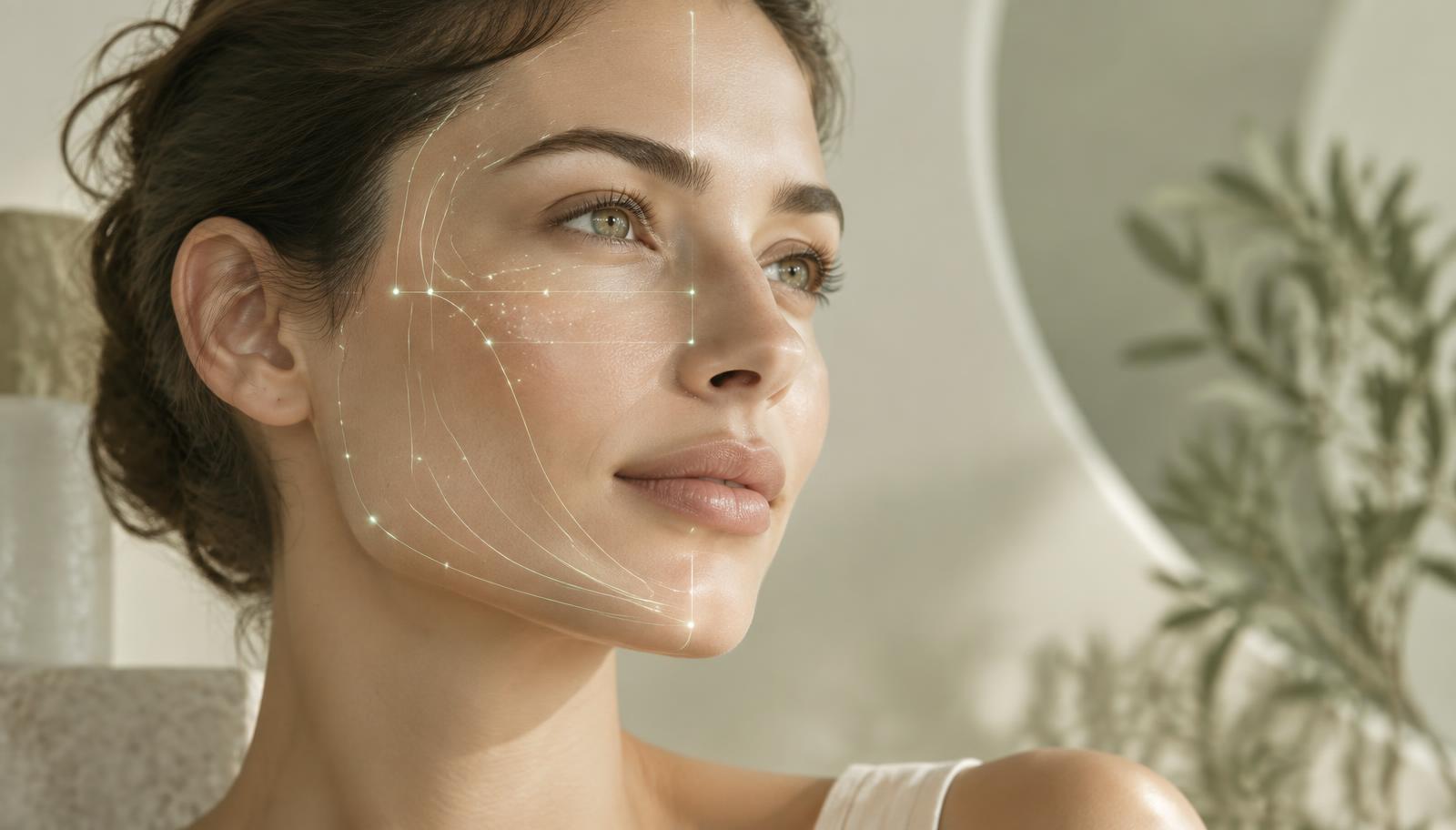
A useful face-analysis tool should explain both its suggestions and its uncertainty. This guide distinguishes cosmetic estimates from medical measurements, walks through the actual Dermavitas experience, and shows how to use its output without mistaking a score for a diagnosis. The featured image is illustrative: it does not demonstrate facial-zone detection or a clinical scan.
What can an AI face analyzer assess?
A photograph can show visible features such as uneven-looking tone, surface texture, or areas that appear flaky. An AI model can describe those appearances and suggest questions to consider when choosing cosmetic skincare. It does not physically examine your skin, measure its water content, or test how well its barrier functions.
In Dermavitas, the four displayed categories are hydration, texture, barrier, and tone evenness. Their 0–100 values are AI estimates, not instrument readings or validated clinical scales. A high barrier score does not prove your barrier is healthy, and a low score does not establish damage.
Appearance is not a diagnosis
Similar-looking redness, bumps, or flaking can have different causes. A photo-based cosmetic suggestion cannot reliably establish whether a change is irritation, eczema, rosacea, acne, an allergy, or something else. Do not use an app to identify a disease or choose prescription treatment.
Scores are not proof of improvement
Changes in exposure, makeup, recent products, camera processing, or lighting can change the image without changing your skin. Treat a different score as a prompt to review your routine and how your skin feels, not as proof that a product worked.
How Dermavitas cosmetic skin analysis works
Dermavitas has two related but distinct parts: a questionnaire-based routine builder and optional AI insights. The routine is generated from the preferences you enter; it is not a medical plan derived from a facial scan. The AI feature considers your profile and, when provided, a selfie to offer additional cosmetic observations and ingredient suggestions.
1. Answer six preference questions
After the optional selfie step, select your usual skin type, goals, sensitivities, sunscreen habits, desired routine effort, and budget. These answers determine the AM/PM sequence, ingredient categories, suggested cadence, and price band. The seven-step flow includes six preference questions; it does not ask about climate or scan your existing products.
2. Generate the questionnaire routine
You can skip the photo and build an ordered morning and evening routine without registering. Review the steps against your experience of dryness, discomfort, and product tolerance. Questionnaire results are cosmetic guidance, not a diagnosis or individualized medical advice.
3. Open optional AI insights with a free account
Signed-in users can receive AI-estimated scores, observations, ingredient suggestions, and a gradual introduction plan. The model can also use questionnaire context, so the presence of a score does not mean a selfie supplied a measured biological value. Free AI usage is limited; access does not imply unlimited analysis.
4. Review the explanation, not just the number
Compare suggestions with your reported sensitivities and current comfort. Do not add several strong ingredients just because an estimate is low. If the explanation does not fit what you see or feel, keep your routine simple and seek professional advice for persistent symptoms.
What Dermavitas does not claim to measure
The current feature does not promise facial landmark segmentation, calibrated pore counts, measured oil production, a biological skin age, or a clinical hydration test. We have not published a clinical validation study establishing diagnostic accuracy or comparable performance across skin tones, cameras, and lighting conditions. No accuracy percentage is claimed here.
These boundaries matter because persuasive presentation is not evidence. The FTC explains that health-related marketing claims must be truthful, not misleading, and supported by appropriate scientific evidence. A polished report should never be confused with validated medical testing. [1]
- No diagnosis of acne, eczema, rosacea, or barrier damage.
- No mole assessment, cancer screening, or reassurance that a suspicious spot is safe.
- No prescription treatment recommendations or replacement for a clinician.
- No guarantee that a score or cosmetic routine predicts an outcome.
How to take a more useful selfie
Use an unfiltered photo in even, natural light. Face the camera at eye level, keep hair away from your face, and avoid makeup if you want the image to show your skin rather than coverage. Avoid direct glare and deep shadows. These steps reduce obvious distractions; they do not make the result clinically accurate.
If you later compare photos, use similar lighting, camera distance, and recent product conditions. Look at the images alongside comfort and tolerance rather than treating small score differences as meaningful change. Dermavitas does not prescribe a medically validated rescanning interval.
How to use cosmetic insights in a skincare routine
Start with the basics instead of trying to correct every estimated category at once. The American Academy of Dermatology recommends gentle cleansing with lukewarm water, avoiding scrubbing, and applying moisturizer when skin is dry or itchy. Its sunscreen guidance recommends broad-spectrum protection with SPF 30 or higher. [2, 3]
Use your questionnaire preferences to keep the routine manageable. Review ingredient information before adding a treatment, avoid ingredients you know you react to, and stop a new product if it causes irritation. If your skin is uncomfortable or inflamed, do not use an AI estimate as a reason to intensify exfoliation.
When to see a dermatologist instead of using an app
Seek professional assessment for persistent, painful, worsening, or unexplained skin changes. The AAD specifically advises seeing a dermatologist for a spot that differs from others, changes, itches, or bleeds. Do not upload a suspicious mole and rely on a reassuring app response. [4]
A dermatologist can examine a lesion and arrange appropriate testing. The AAD explains that a skin biopsy is needed to diagnose melanoma; a consumer selfie analysis cannot provide that confirmation or rule it out. [5]
How to choose an AI face analyzer responsibly
Choose a tool for understandable cosmetic guidance, not for the largest collection of precise-looking numbers. Check whether it distinguishes observations from measurements, publishes evidence for any accuracy claims, explains account requirements and limits, and offers accessible photo-retention information.
Dermavitas is most relevant when you want to organize cosmetic ingredient choices and an AM/PM routine around your stated preferences. It is not the right tool for a medical diagnosis. No universal ‘best’ analyzer can be established from this article, and we do not claim an independent ranking.
- Look for explicit cosmetic-only scope and uncertainty.
- Ask what each score represents and whether it has been clinically validated.
- Read photo-use, retention, deletion, and provider information before uploading.
- Check free-account requirements and paid features before choosing a service.
Try the Dermavitas routine builder and optional AI insights
Start at /analysis using the ‘Start free analysis’ button below. A selfie is optional and the questionnaire routine does not need an account. Create a free account if you want the AI insights; no payment is required for the free tier, which has usage limits.
Premium adds Scan My Shelf, saved routines, progress photos and reminders, and AI Skin Coach access. These features organize your cosmetic routine; they do not turn a selfie report into medical care. Review the current Free and Premium comparison on the pricing page before upgrading.
Signed-in uploads can be saved privately to your account. Review the Privacy Policy for photo handling and AI-provider details. The policy says Dermavitas does not use photos to train its own models; that is not a blanket guarantee about every provider’s policies.
Frequently asked questions
What is an AI face analyzer?
It is software that interprets a facial photo to suggest visible cosmetic characteristics. Dermavitas combines optional AI estimates with a separate questionnaire-based skincare routine. It is not a medical examination.
Is Dermavitas AI face analysis free?
The questionnaire routine is free and works without an account or photo. Optional AI insights require a free account and have usage limits. Premium adds features such as shelf scanning, saved routines, and progress tracking.
How accurate is a selfie skin analysis?
Accuracy depends on the specific task, model, image, and validation evidence. Dermavitas has not published clinical validation establishing diagnostic accuracy. Its cosmetic scores are estimates, not measurements or disease probabilities.
Can an AI face analyzer detect skin barrier damage?
No. It can suggest that a photo looks flaky or irritated, but it cannot measure barrier function or confirm damage. Persistent stinging, itching, redness, or inflammation should be assessed by a qualified clinician.
Can it screen moles or diagnose skin cancer?
No. Do not use Dermavitas to assess a suspicious mole or rule out cancer. The AAD recommends a dermatologist for changing, itching, bleeding, or unusual spots; melanoma diagnosis requires appropriate clinical assessment and biopsy.
Do I have to upload a selfie?
No. Skip the optional photo step and answer the six preference questions to generate a morning and evening routine. A photo can add context for optional AI insights, but it is not required for the routine builder.
Does Dermavitas analyze facial zones or count pores?
The current defined scores are hydration, texture, barrier, and tone evenness. Dermavitas does not claim calibrated pore counts, facial-zone segmentation, measured oil levels, or biological skin-age readings.
How should I compare repeated analyses?
Use similar lighting and camera conditions, and review photographs alongside comfort and product tolerance. A score change alone does not prove improvement. No medically validated rescanning schedule is claimed.
Sources and further reading
Sources checked October 27, 2026. Numbered references in the guide correspond to the links below. These organizations do not endorse Dermavitas. The featured photograph is illustrative and AI-generated.
Keep reading
AI skincare
AI skincare: how artificial intelligence improves your face routine (and where it falls short)
15 minAI skincare
AI skin analysis: what it is, how it works, and how to get a real routine from a free scan
16 minAI skincare