AI skincare · August 12, 2026
Fitzpatrick skin type: how to find yours, and what it changes about your skincare routine
The short answer
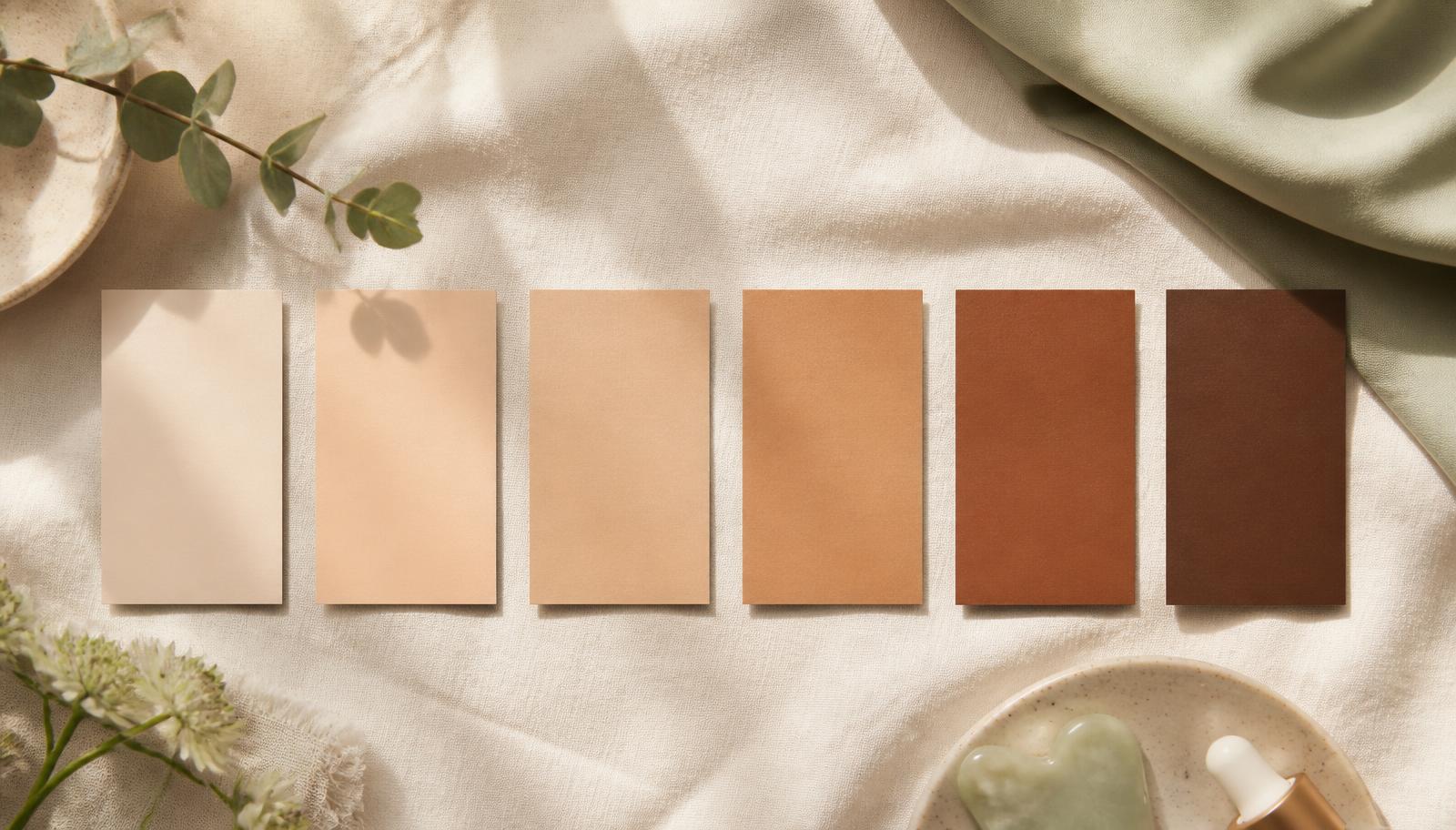
Your Fitzpatrick skin type is a 1-to-6 classification of how your skin responds to sun exposure, not how light or dark it appears. Type I always burns and never tans; Type VI is deeply pigmented and rarely burns. You find yours by answering how your untanned skin reacts to 30 minutes of midday sun the first time each season: if it reliably burns you are I-II, if it burns then tans you are III-IV, and if it tans without burning you are V-VI.
The Fitzpatrick scale is the most widely used skin classification in dermatology, and also the most widely misread. It gets treated online as a skin-tone chart, matched to foundation shades and undertones. It was never that. Dermatologist Thomas Fitzpatrick designed it in 1975 to answer one practical clinical question: how much ultraviolet light can this person take before their skin burns? That is why the scale is built from behaviour — burning and tanning — rather than from colour. Knowing your type is genuinely useful, because it predicts how carefully you need to handle sun exposure, how likely a dark mark is to follow a breakout, and how gently you should introduce strong actives. This guide places you on the scale in a couple of minutes, then translates the number into decisions you can actually apply to a routine.
What the Fitzpatrick scale actually measures
The scale describes photosensitivity: your skin's reaction to ultraviolet radiation. Fitzpatrick built it originally so clinicians could dose UV phototherapy safely, and the two questions it rests on are simple. First, does your untanned skin burn when exposed to strong midday sun for about half an hour? Second, does it go on to develop a tan?
Because the answers correlate loosely with visible pigmentation, people assume the scale is about colour. It is not, and the difference matters. Two people can look similar in a photo and sit on different types because one burns first and one browns first. Constitutive pigmentation — the colour of skin never exposed to sun, such as your inner upper arm — is a better reference point than your face in summer.
The scale is also self-reported. There is no lab test. That makes it fast and free, and also imprecise, which is why it belongs in the category of useful heuristics rather than measurements.
- It grades reaction to UV, not shade, undertone, or ethnicity.
- Judge from untanned skin, at the start of a sun season.
- It is self-reported, so treat it as a range rather than a verdict.
The six Fitzpatrick skin types, described honestly
Read these as descriptions of behaviour. If two adjacent types both sound partly right, you are probably on the boundary, and picking the more cautious of the two is the safer default for sun and for actives.
- Type I — very fair skin, often with freckles. Always burns, never tans. Highest UV caution of any type.
- Type II — fair skin. Burns easily, tans minimally and with difficulty.
- Type III — light to medium skin. May burn on first strong exposure, then tans gradually to a light brown.
- Type IV — olive or moderate brown skin. Burns rarely and only with heavy exposure, tans easily and well.
- Type V — brown skin. Very rarely burns, tans profusely and quickly.
- Type VI — deeply pigmented dark brown to black skin. Almost never burns.
How to determine your Fitzpatrick skin type in two minutes
Answer three questions about your skin, not about your appearance in general. Use your memory of early-season sun, before any tan has built up.
One: after roughly 30 minutes of unprotected midday summer sun on untanned skin, what happens in the next 24 hours? Painful redness that peels points to I or II. Mild redness that fades to colour points to III or IV. No redness at all points to V or VI.
Two: over a full season of moderate exposure, how much tan do you actually develop? None or freckling only sits at I-II. A light, even brown sits at III. A deep tan that arrives quickly sits at IV-V.
Three: what colour is your skin where the sun never reaches it? This anchors you if the first two answers disagree. Very pale with pink or ivory tones sits low on the scale, light beige to olive sits mid, and brown to deep brown sits high.
If you land between two types, the practical answer is to take the lower number's sun advice and the higher number's pigmentation advice. That combination is protective in both directions.
- Burn reaction is the primary signal; tanning ability is the tiebreak.
- Reference untanned skin, such as the inner upper arm.
- Boundary cases are normal — plan for the more cautious neighbour.
Where the scale falls short
The Fitzpatrick scale was developed on a largely white patient population, and types V and VI were added later to extend it. As a result, it compresses an enormous amount of variation into two categories at the deeper end, which is one reason it is a poor tool for describing skin of colour with any precision. Researchers and clinicians have proposed alternatives and supplements — reflectance spectrophotometry, the Roberts skin type classification, individual typology angle — precisely because self-reported burning is a crude proxy.
It also says nothing about the axis most people mean when they say "skin type": oily, dry, combination, or sensitive. Those describe sebum output and barrier behaviour. You can be Fitzpatrick III and oily, or Fitzpatrick III and dry. The two systems answer different questions, and a routine needs both answers.
Finally, no type is a shield. Skin cancer occurs across every Fitzpatrick type, and later diagnosis at the deeper end of the scale is a documented problem. A high number means a lower burn risk, not a licence to skip protection or skip a mole check.
- Types V-VI flatten a very wide range of deeper skin tones.
- It does not describe oily, dry, combination, or sensitive skin.
- Every type needs sun protection and professional skin checks.
What your type changes about sunscreen
Everyone benefits from daily broad-spectrum sunscreen, and the minimum standard does not move with your type: SPF 30 or higher, applied to every exposed area, reapplied every two hours of real outdoor exposure. What changes with type is the margin for error and the formula most likely to keep you consistent.
At types I-II, burn risk is the dominant concern, so shade, clothing, and reapplication discipline carry most of the weight. At types IV-VI, the more common visible consequence of UV is pigmentation rather than burning — melasma and dark marks that deepen and take months to fade. Visible-light exposure also contributes to pigmentation in deeper skin, which is the argument for tinted mineral formulas with iron oxides when uneven tone is your main concern.
The formula only works if you wear it. Modern chemical filters tend to disappear on deeper skin without a cast; mineral formulas suit reactive skin but usually need a tint above type III. Pick the one you will reapply.
- Every type: SPF 30+, broad spectrum, daily, reapplied outdoors.
- Types I-II: prioritise avoidance, coverage, and reapplication timing.
- Types IV-VI: consider tinted mineral filters with iron oxides for pigment control.
What your type changes about actives and pigmentation
Higher Fitzpatrick types have more reactive melanocytes, which means inflammation is more likely to leave a visible dark mark behind. That is post-inflammatory hyperpigmentation, and it is the single most important routine consequence of sitting at type IV, V, or VI. A spot that heals in a week can leave a mark that lingers for months.
The implication is counterintuitive: the more prone you are to marks, the gentler your introduction of strong actives should be. Aggressive scrubbing, high-strength peels used too often, and picking are the reliable ways to trade a two-day blemish for a two-month shadow. Low and slow beats fast and irritating.
A workable pattern at any type is to introduce one active at a time, at the lowest useful strength, two or three nights a week, and hold that for four to six weeks before increasing. Retinoids, azelaic acid, niacinamide, and vitamin C all have reasonable evidence for tone and texture, and all of them work better on skin that is not inflamed.
Lower types are not exempt — they simply tend to show sun damage as redness, broken capillaries, freckling, and fine lines rather than as dark patches, so the same restraint applies with a different visible outcome.
- Types IV-VI: treat irritation itself as a pigmentation risk.
- Add one active at a time and judge after a full skin cycle.
- Never pick — trauma is the fastest route to a lasting mark.
How Dermavitas uses this in an analysis
When you run a free Dermavitas analysis, the questionnaire asks how your skin behaves in sun alongside questions about oiliness, sensitivity, and your current concerns. Those answers are cosmetic inputs, not a clinical classification, and they shape the routine you get: how conservatively actives are introduced, whether a tinted sunscreen is suggested, and how much weight the plan puts on even tone versus texture or congestion.
The photo step reads visible cosmetic characteristics — shine, visible texture, congestion, unevenness by area — and the questionnaire supplies the context a single image cannot. The output is an AM/PM routine with an explicit application order, ingredient categories, and pacing.
Dermavitas offers cosmetic guidance only. It does not assign you a medical Fitzpatrick classification, diagnose conditions, or replace a dermatologist — and for anything changing, painful, or persistent, a licensed dermatologist is the right next step.
Frequently asked questions
What is a Fitzpatrick skin type?
It is a six-level classification, developed by dermatologist Thomas Fitzpatrick in 1975, describing how a person's skin responds to ultraviolet light. Type I always burns and never tans, and Type VI is deeply pigmented and almost never burns. It was created to dose UV phototherapy safely, and it is still used to estimate sun sensitivity.
How do I know what my Fitzpatrick skin type is?
Ask what your untanned skin does after about 30 minutes of unprotected midday summer sun. Painful burning with peeling and no tan is Type I or II. Some redness followed by a gradual tan is Type III. Rare burning with an easy deep tan is Type IV or V. No burning at all on deeply pigmented skin is Type VI.
Can you determine Fitzpatrick skin type from a photo?
Not reliably. The scale is defined by how skin reacts to UV, and a photo only shows current colour, which is affected by tanning, lighting, camera processing, and makeup. Image analysis can estimate visible tone, but the burn-and-tan history has to come from you, which is why questionnaires remain the standard.
What is true of Fitzpatrick skin types 5 and 6?
They describe brown to deeply pigmented skin that tans readily and very rarely burns. Higher baseline melanin gives some intrinsic UV protection, but it does not prevent skin cancer or photoageing, and these types are the most prone to post-inflammatory hyperpigmentation and melasma — so irritation control and daily sun protection still matter.
Is Fitzpatrick type the same as oily, dry, or combination skin?
No. Fitzpatrick describes sun reactivity and pigmentation. Oily, dry, combination, and sensitive describe sebum production and barrier behaviour. They are independent, and a routine needs both: your Fitzpatrick type informs sun and pigment strategy while your oil and sensitivity profile informs textures and actives.
Does a higher Fitzpatrick type mean I can skip sunscreen?
No. Deeper skin burns less easily but still accumulates UV damage, still develops melasma and dark marks, and still gets skin cancer — often diagnosed later. Broad-spectrum SPF 30 or higher daily is the standard for every type, and tinted mineral formulas with iron oxides can help specifically with pigmentation.
Why is the Fitzpatrick scale criticised?
It was developed on a mostly white population, with types V and VI added afterwards, so it compresses a very wide range of deeper skin tones into two categories. It is also entirely self-reported. Alternatives such as reflectance spectrophotometry, individual typology angle, and the Roberts classification exist to address that imprecision.
Which Fitzpatrick type is most common?
It depends entirely on the population being described, so there is no single global answer. Rather than looking for an average, place yourself using your own burn-and-tan history — that is the only version of the answer that changes what you should do.
Keep reading
AI skincare
AI skincare: how artificial intelligence improves your face routine (and where it falls short)
15 minAI skincare
AI skin analysis: what it is, how it works, and how to get a real routine from a free scan
16 minAI skincare