AI skincare · August 16, 2026
How to know your skin type at home: the bare-face test dermatology actually uses
The short answer
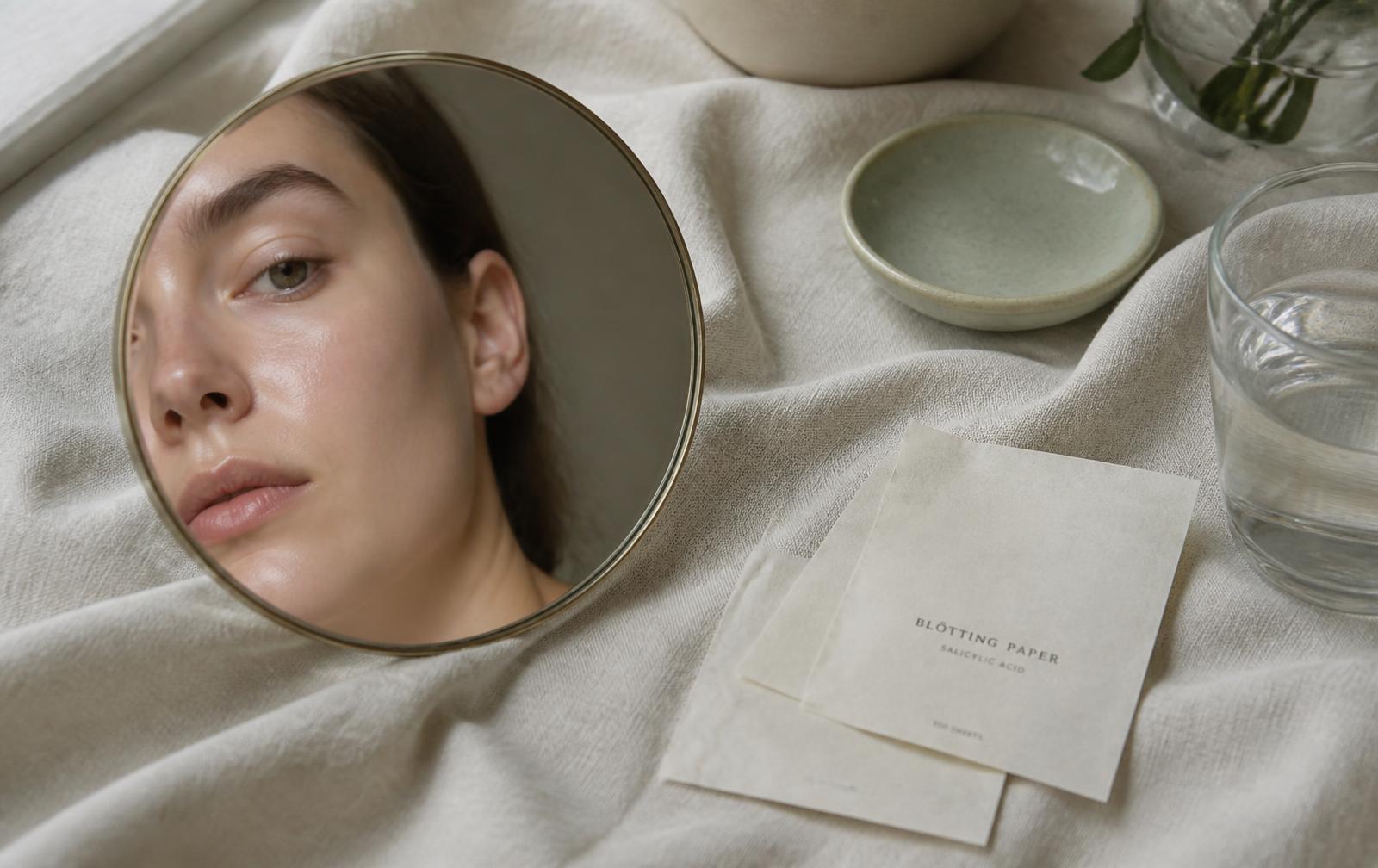
Wash your face with a plain, non-foaming cleanser, apply nothing afterwards, and wait two hours in a normal room. Then look: shine across forehead, nose and chin only means combination; shine everywhere means oily; tightness and flaking with no shine means dry; comfortable with neither means normal; and stinging or redness on top of any of those means sensitive. Blotting paper makes the reading obvious — press it to your T-zone and cheek separately and compare how much oil each lifts.
Almost every skincare mistake traces back to one wrong assumption about the face doing the buying. People with dehydrated oily skin buy rich creams that clog them. People with dry skin buy oil-control cleansers that strip them further. People with a compromised barrier buy exfoliating acids for the flaking the acids are causing. Skin type is not a fixed identity or an aesthetic — it is a short, checkable description of how much sebum your skin produces and how well it holds water. The test takes two hours of doing nothing, costs nothing, and it is what a clinician effectively does by looking at your bare face. This guide walks the test, then translates each result into the four routine decisions type actually changes.
The bare-face test, step by step
The point of the test is removing every variable except your own skin. Products, makeup, hot water and humidity all counterfeit a skin type, which is why a reading taken right after a shower or at the end of a workday is meaningless.
Do it in the morning if you can, in a room at normal temperature, and do not touch your face while you wait. Two hours is the window where sebum has resurfaced but the day has not interfered yet.
- Cleanse once with a plain, fragrance-free, non-foaming cleanser — no scrub, no acid, no oil-control claim.
- Pat dry with a clean towel and apply nothing at all: no serum, moisturizer, sunscreen, or makeup.
- Wait two hours in a normal indoor room. Do not exercise, shower, or touch your face.
- Look in indirect daylight rather than bathroom downlights, which exaggerate shine.
- Press a blotting paper to your forehead and nose, then a fresh one to a cheek, and compare the two.
Reading your result: the five types
Read the result as a pattern across zones, not as a single verdict for the whole face. Where the oil sits matters more than whether oil exists.
- Normal: comfortable, no tightness, no visible shine, blotting paper lifts almost nothing. Pores are unremarkable and the face feels the same at hour two as at minute one.
- Oily: shine on forehead, nose, chin and cheeks; both blotting papers come away translucent. Pores are visible across the face and makeup tends to slide by midday.
- Dry: tightness, a matte or slightly rough finish, possible fine flaking around the mouth or along the jaw. Blotting paper lifts nothing anywhere. Fine lines look more pronounced when unmoisturized.
- Combination: an oily T-zone with normal or dry cheeks — the most common adult result. The forehead paper is oily, the cheek paper is clean.
- Sensitive: not a separate oil level but a reactivity layered on top of one. Stinging, warmth, flushing, or itching from plain products, and visible redness that comes and goes.
Dry versus dehydrated: the distinction that fixes most routines
Dry skin lacks oil. Dehydrated skin lacks water. They feel similar and need opposite products, which is why this is the single most useful correction in skincare.
Dry skin is a type — it produces little sebum, it is that way most of the year, and it improves with lipids: ceramides, squalane, richer occlusive creams at night. Dehydrated skin is a temporary state that any type can enter, including oily skin, and it improves with water-binding humectants: glycerin, hyaluronic acid, panthenol, plus fixing whatever caused it.
The tell is oil with tightness at the same time. If your face is shiny by lunch yet feels tight and looks dull, you are oily and dehydrated — usually from over-cleansing, too-frequent exfoliation, hot water, or a retinoid introduced too fast. Adding a heavy cream there makes congestion worse without solving the water problem.
- Dry: little oil all year, flaking, improves with ceramides and richer creams.
- Dehydrated: tight and dull but still shiny, improves with humectants and less stripping.
- Common cause of dehydration: foaming cleanser twice daily plus acids more than twice a week.
Why your skin type changes, and how often to retest
Skin type is stable over months, not years. Sebum output falls with age, so the oily teenager frequently becomes the combination thirty-year-old and the dry fifty-year-old. Winter air and indoor heating push most faces one step drier; humid summers push them one step oilier.
Hormonal shifts — cycle, pregnancy, perimenopause, starting or stopping hormonal contraception — move oil production too, as do isotretinoin, some antidepressants, and diuretics. Moving cities changes it. So does starting a retinoid, which often causes six weeks of dryness that is adjustment rather than a type change.
Retest at the change of each season and after any medication change. A routine tuned to last winter's skin in August is the reason a lot of people think their products stopped working.
- Retest twice a year minimum: once in cold weather, once in warm.
- Wait six weeks after starting a retinoid before calling yourself dry.
- Judge by how skin behaves for a month, not by one bad week.
What each type actually changes in a routine
Type changes fewer things than the industry implies. Cleanser strength, moisturizer texture, active pacing and sunscreen finish — that is close to the whole list. Everyone, regardless of type, needs to cleanse, hydrate, protect, and pace actives sensibly.
Oily skin: gel or light lotion moisturizer, a gentle gel cleanser at night, niacinamide or a BHA to manage congestion, and a fluid or gel sunscreen. Skipping moisturizer is the classic oily-skin error — it raises oil output and dehydration together.
Dry skin: cream cleanser or balm, a ceramide-rich moisturizer applied to slightly damp skin, occlusives at night, and retinoids introduced at low strength twice weekly. Foaming cleansers and high-percentage acids are the things to give up.
Combination skin: treat zones, not the whole face. Light moisturizer everywhere and a richer layer on the cheeks, actives on the T-zone first, and a single sunscreen you will actually reapply.
Sensitive skin: fragrance-free, short ingredient lists, one new product at a time with a five-day gap, patch test behind the ear, and mineral sunscreen if chemical filters sting. Introduce actives at the lowest available strength and buffer them with moisturizer.
Where a photo-based analysis beats a mirror
The bare-face test tells you your type. It does not tell you the order to use what you own, which of your actives can share a night, or which product on your shelf is the redundant one. That is the gap Dermavitas fills: a selfie plus six questions returns an AM and PM routine with application order, ingredient reasoning, and the nights each active runs.
It also helps with the honest limitation of self-assessment — most people underrate shine on the cheeks and overrate flaking around the nose. An estimate from a photo, clearly labelled as a cosmetic estimate rather than a clinical measurement, is a useful second opinion alongside your own reading.
One boundary worth stating plainly: persistent redness, painful or cystic acne, scaling patches, or anything changing in size or colour is a dermatologist's territory, not a skin-type question. Cosmetic guidance sits on top of medical care, never in place of it.
- Free skin analysis: a routine built for your type and the products you already own.
- Routine Conflict Checker: see which actives can share a night before you irritate your barrier.
- Should I Buy This?: check a product against your type before it joins the shelf.
Frequently asked questions
How do I know my skin type at home?
Wash with a plain non-foaming cleanser, apply nothing, and wait two hours in a normal room. Shine only on the forehead, nose and chin is combination; shine everywhere is oily; tightness or flaking with no shine is dry; comfortable with neither is normal. Stinging or flushing from mild products indicates sensitive skin on top of whichever oil level you have.
Can you have oily and dry skin at the same time?
Yes — that is either combination skin, where the T-zone is oily and the cheeks are dry, or oily skin that is dehydrated, where the face shines but still feels tight. The first is a type and needs zone-specific products; the second is a temporary state usually caused by over-cleansing or too much exfoliation, and it needs humectants plus a gentler routine.
Does skin type change with age or season?
It does. Sebum production declines over the decades, so oily skin often becomes combination and then dry. Cold, dry air and indoor heating push skin one step drier for the winter, while heat and humidity push it oilier. Retest at each change of season and after any hormonal or medication change.
Is sensitive skin a skin type?
It is better understood as a reactivity that layers on top of normal, dry, oily, or combination skin. You can be oily and sensitive, or dry and sensitive. What it changes is method rather than category: fragrance-free formulas, one new product at a time, patch testing, and the lowest strength of any active.
How accurate are online skin type quizzes?
A quiz is only as accurate as the observation behind it, so do the bare-face test first and answer from what you actually saw rather than from memory. A photo-based analysis adds a useful second opinion because most people misjudge shine on their cheeks, but neither is a clinical measurement.
Should I moisturize if my skin is oily?
Yes. Skipping moisturizer leaves oily skin dehydrated, which usually increases shine and congestion. Use a light gel or lotion with glycerin or hyaluronic acid rather than a rich cream, and keep a gentle cleanser so you are not stripping the barrier you are trying to hydrate.
Keep reading
AI skincare
AI skincare: how artificial intelligence improves your face routine (and where it falls short)
15 minAI skincare
AI skin analysis: what it is, how it works, and how to get a real routine from a free scan
16 minAI skincare